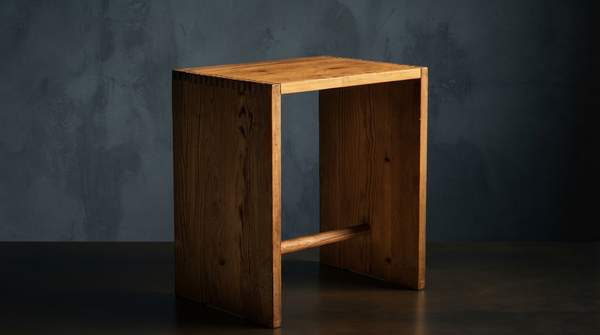
Max Bill's "concrete art" rests on a single conviction that art, design and everyday life should follow shared mathematical and geometric principles, and the Swiss designer spent his career testing it on everything from watches to buildings. Three tenets define the philosophy: a mathematical and logical foundation, the rejection of subjective expression, and the belief that beauty arises when form serves function. Nowhere is the translation from abstract idea to tangible object clearer than in the Ulm Stool, the modest wooden seat he created with Hans Gugelot for the school he co-founded, the Hochschule für Gestaltung in Ulm.
The Foundations of Concrete Art: Max Bill's Philosophy
Bill was, by the account of the Masterworks Academy profile, "one of the twentieth century's most complete design polymaths" — painter, sculptor, architect, graphic and industrial designer — yet all of it flowed from that one unifying conviction. Trained at the Bauhaus under Josef Albers, László Moholy-Nagy, Paul Klee, Wassily Kandinsky and Oskar Schlemmer, he carried that program from Weimar-era Germany into postwar Switzerland, Brazil and West Germany, most visibly through the Ulm school.
The movement Bill joined and led had its own character. Vertu Fine Art describes the Concrete Art movement, which began in the 1930s, as holding that a work of art should emanate from the mind of the artist "without sentiment," and appear "more machine made than hand made." Much of the work Bill and other concrete artists produced was based on mathematical concepts centered on basic planes, forms and color. In 1944, Bill organized the first international exhibition of Concrete Art, committing the movement to public view.
Mathematical Precision and Logical Structure
The first tenet is the most literal: the artwork is built, not expressed. Bill's long association with the Belgian artist Georges Vantongerloo, formed in the Abstraction-Création collective in 1930s Paris, was rooted in their shared exploration of mathematics and abstract art, as HENI News recounts. Basic planes, forms and color are the vocabulary; mathematical relationships supply the grammar. This is why the movement's objects can look industrial even when made by hand — the logic of the construction, not the gesture of the maker, determines what the viewer sees.
The Rejection of Subjective Expression
The second tenet is subtractive. Bill's own formulation, quoted by The Art Story, is absolute in its exclusion: "It shall not receive anything of nature's or sensuality's or sentimentality's formal data." Nothing derived from observation, mood or personal feeling is permitted into the work's formal structure. In a 1972 interview he framed the stakes in civic terms, saying art "has a unique opportunity to form a counterpoint to the technology-ridden, polluted and commercialized consumer civilization." The discipline of exclusion was not coldness for its own sake; it was a claim that objects freed of sentiment could communicate universally.
The Synthesis of Function and Aesthetics
The third tenet binds the other two to daily life: aesthetic form and practical purpose are combined, not traded off. HENI News points to Bill's iconic timepieces for Junghans as objects that demonstrated his belief in uniting the two. The Art Story describes the philosophy more expansively — that no aspect or object of modern life could not be redesigned in more rational, practical and beautiful ways — and notes that during his time at Ulm, Bill designed everything from electrical plugs, clocks, stools and watches to multi-story buildings.