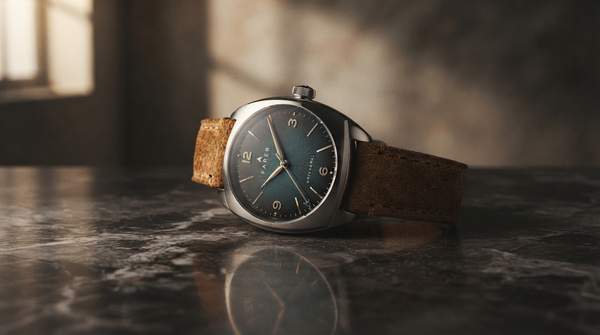
The cushion watch case—a square or tonneau-like form with softly rounded corners—sits deliberately between two horological traditions. It borrows the geometry of Art Deco while avoiding the sharp edges that make square cases difficult to wear, and it offers more visual character than a conventional round case. Born in the 1920s, adapted for mid-century divers, and reinterpreted by contemporary makers, it remains, as the dive-watch maker Aquastar puts it, "a deliberate aesthetic choice rather than a performance feature"—one whose appeal rests on a specific trade-off between comfort and wrist presence.
The Enduring Appeal of the Cushion Case
In watchmaking, the case is never just a container. As a recent survey of modern cushion designs in Outlook Luxe observes, the silhouette decides how a watch sits on the wrist, how light catches its edges, and how a dial is framed. Round cases brought classical order; rectangular ones carried Art Deco's geometry. The cushion case occupies the ground between them: square enough to feel architectural, rounded enough to be comfortable. That balance, rather than any technical advantage, explains why the shape has survived a century of changing tastes and why contemporary watchmakers keep returning to it with updated finishes, movements, and dial treatments.
Art Deco Origins: Elegance of the Early 20th Century
The cushion case emerged when the watch moved off the chain and onto the wrist. In the 1910s and 1920s, designers were suddenly free to experiment with shapes the round pocket watch had never allowed, and Art Deco taste favored geometry, symmetry, and bold outlines—the cushion case fit that mood exactly. Hamilton, one of the era's most creative manufacturers, began exploring forms beyond the traditional round and square case in the 1920s; its Cushion, introduced in 1926, combined a softly curved silhouette with architectural lines and became one of the period's most distinctive designs. The shape soon appeared on dress watches and early sports models alike before fading as round cases reasserted their dominance after the war.
Function arrived early, too. The vintage Rolex Oyster Cushion of the 1920s, as the watch specialist Geckota notes, blended the shape's elegance with water resistance that was groundbreaking for the time—an early signal that the geometry could serve practical purposes, not just decoration.