In haute couture, no precious fabric is cut until a humble prototype has done its work. The toile — an unbleached cotton muslin, pronounced "twahl" — is the intermediate step that bridges the designer's two-dimensional sketch and the three-dimensional reality of a garment made to a client's exact measurements. Its lifecycle follows a discernible sequence: initial draping on a dress form, refinement by the atelier's artisans, a first fitting on the client herself, and finally deconstruction into the paper pattern that guides construction in the final fabric. Understanding those stages is the key to understanding why couture fit cannot be achieved any other way.
The Toile: Haute Couture's Essential Prototype
The toile is far more than a rough draft. As the fashion house SELVANE describes it, the toile is "the crucible where abstract vision coalesces into tangible form," the crucial intermediate step between the sketch and the garment destined to adorn the human body. The distinction matters because haute couture, by definition, produces unique pieces handmade to a client's exact measurements — Maison Julien Fournié contrasts this directly with ready-to-wear, which is mass-produced in standardized sizes. A toile is therefore not a sample in a standard size but a working model of one specific garment for one specific body, and its purpose is to make every fit decision — every pinch of excess volume, every redrawn seam — while the fabric is still cheap, plain cotton rather than silk or embroidery-grade material.
The Metropolitan Museum of Art's essay on haute couture adds the structural context: garment creation happens in the house's own workrooms, under the daily surveillance of the designer, and fit — "both in its tailored form and in its dressmaking variant" — is inevitably part of the value of couture. The toile is the instrument through which that value is secured.
The Four Stages of a Couture Toile's Journey
Descriptions of the couture process are often scattered across a house's account of its fittings and a museum's account of its ateliers. Assembled chronologically, they resolve into a four-stage lifecycle, each stage with a distinct activity, purpose, and set of skills:
| Stage | Activity | Purpose and Skills |
|---|---|---|
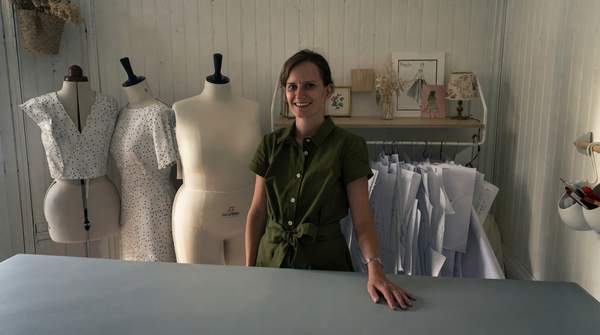
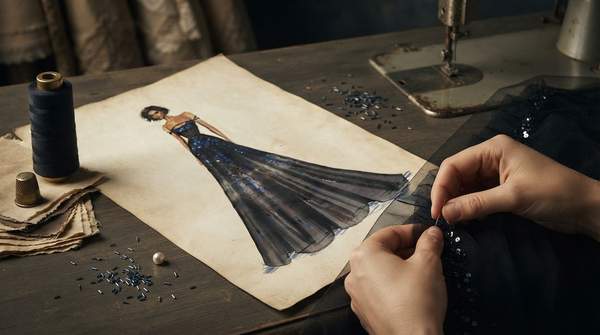
| Stage 1: Concept to 3D Form | The toile begins as a cotton prototype, draped and cut on a dress form or mannequin. | This translates the initial 2D sketch into a three-dimensional form; the design process may begin with sketches or directly with the draped muslin itself. |
| Stage 2: Atelier Refinement | Skilled artisans in the atelier refine the toile, making adjustments and markings. | This iterative process perfects the garment's fit, cut, and silhouette. |
| Stage 3: Client Fitting | The toile is fitted on the client, allowing for personalized adjustments. | This critical stage ensures an impeccable, bespoke fit to the individual's body. |
| Stage 4: Deconstruction to Blueprint | Once approved, the adjusted toile is carefully deconstructed to create the final paper pattern. | This pattern serves as the precise blueprint for constructing the garment in the final, precious fabric. |
Two specialized workrooms supply the skills that carry the toile through these stages. The couture house is customarily composed of two parts, according to the Met's account: one devoted to dressmaking, the atelier flou, and one devoted to tailoring suits and coats, the atelier tailleur, with skilled workers in each area practicing the arts apposite to that area.