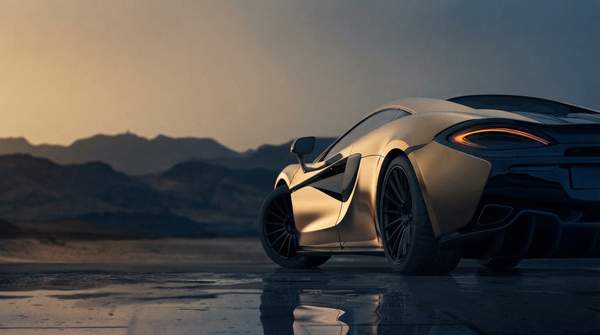
A supercar earns its investment case on two fronts: it must fit a recognized collector thesis — a "last-of-their-kind" internal-combustion model, a limited or special edition, or a rare manual-transmission car — and it must be bought after its steepest depreciation has already been absorbed, typically a decade or more after it left the factory. Specialist market commentary converges on this structure, and this guide turns it into a repeatable evaluation method: categorize the car first, then score it against the value-driving factors that collectors actually pay for. None of this is financial advice, and no framework guarantees a return.
Understanding the Supercar Depreciation Curve: Finding the 'Sweet Spot'
The first discipline in supercar investing is refusing to pay for newness. Market analysis from Exotics Hunter describes the value trajectory in distinct phases. In years zero through three, new exotics lose the most value — 20 to 40 percent depending on model and market conditions — and this hits hardest in dollar terms: a $450,000 Ferrari can be worth roughly $350,000 eighteen months later. The drop reflects the disappearance of the "new" premium, including factory-fresh paint, original ownership, and warranty, along with the fading of launch hype and allocation scarcity.
Rosner Motorsports, a luxury-car dealer, frames the same reality from the buyer's side: a brand-new luxury vehicle can lose 15 to 25 percent of its value within the first year alone, though highline marques like Porsche often depreciate less. The practical implication is that the first owner subsidizes everyone after them.
The investment sweet spot arrives when depreciation has largely bottomed out but before collector appreciation begins. Exotics Hunter places this floor roughly 10 to 15 years after original purchase, though the exact timing varies by model and market conditions. The evidence for the pattern is concrete: a 2009 Ferrari F430 that traded around $150,000 to $180,000 in 2015–2016 was reported in the $220,000 to $260,000 range more recently, appreciation attributed to age, scarcity, and the closure of its production era. Older historically significant models moved further still — a late-1980s Ferrari Testarossa reported at $300,000 in 2010 was later estimated at $500,000 to $600,000, and a 550 Maranello bought at $350,000 in 2015 was reported in the $450,000 to $550,000 range. These cars, in the source's words, "have transitioned from used vehicles to collectible assets."